Basics of Cinema in Simple Terms
Cinema can look complicated from the outside.
Camera.
Lights.
Actors.
Editing.
Sound.
Screenplay.
But at its core, cinema is actually very simple:
You have people. They want something. Something stands in their way. They go through an experience. And that experience changes them.
Everything else helps you tell that story better.
1. Start With the Film Story
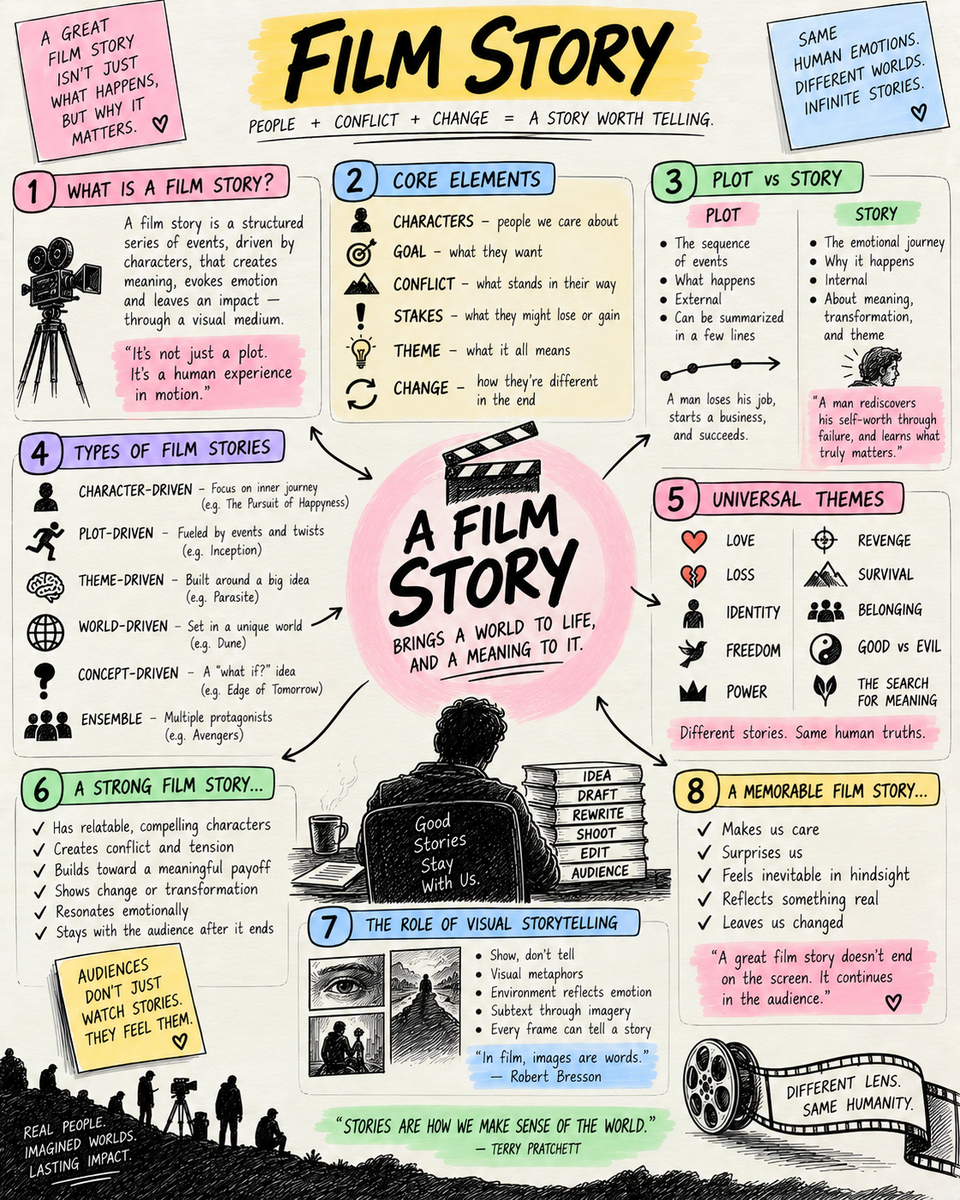
A film story is a structured series of events driven by characters that creates meaning, evokes emotion and leaves an impact through a visual medium.
In simple words:
A film is not just a plot. It's a human experience in motion.
The basic ingredients are:
Characters
People we care about.
Goal
What does the character want?
Conflict
What is stopping them?
Stakes
What do they stand to lose or gain?
Theme
What does the story ultimately mean?
Change
How are they different at the end?
For example, you can say:
A man loses his job and starts a business.
That's the plot.
But the story could be about a man rediscovering his self-worth through failure and learning what actually matters to him.
That's the story.
The plot tells us what happens.
The story tells us why it matters.
2. Understand the Different Types of Film Stories
Not every film is driven in the same way.
Character-Driven
The focus is on the character's internal journey.
The Pursuit of Happyness is an example.
Plot-Driven
The story is primarily driven by events, twists and what happens next.
Inception is a good example.
Theme-Driven
The film is built around a larger idea.
Parasite explores themes around class and inequality.
World-Driven
The world itself becomes a major part of the storytelling.
Dune is an example.
Concept-Driven
The story begins with a strong “What if?” idea.
Edge of Tomorrow is an example.
Ensemble
Multiple protagonists share the story.
The Avengers is an example.
Different approaches.
Different films.
But the fundamentals remain the same:
People + Conflict + Change = A Story Worth Telling
3. Learn the Difference Between Plot and Story
This is one of the most important things for a filmmaker to understand.
Plot:
What happens?
External events
Sequence of events
Can often be summarised in a few lines
Story:
Why does it happen?
Internal journey
Meaning
Transformation
Emotional experience
A plot can tell us:
A man loses his job and starts a business.
But the story could tell us:
A man who has always measured his worth through his career loses everything and slowly discovers that his value doesn't depend on his success.
Now there is an emotional journey.
That's what audiences connect with.
4. Understand Structure
Once you have a story, you need to understand how to shape it.
The simplest framework is the Three-Act Structure.
ACT I — SETUP
Introduce:
the world,
the protagonist,
their normal life,
what they want,
the central problem.
Then something happens that changes everything.
That's the inciting incident.
ACT II — CONFRONTATION
The protagonist tries to achieve their goal.
But things become increasingly difficult.
There are:
obstacles,
failures,
new characters,
complications,
higher stakes.
A major midpoint event changes the direction of the story.
Eventually, the protagonist reaches their darkest moment.
ACT III — RESOLUTION
The protagonist faces their biggest challenge.
This leads to the climax.
We then see the consequences and the new reality.
The important question isn't only:
“What happened?”
It's:
“How did everything that happened change the character?”
5. Learn Other Story Structures Too
The Three-Act Structure isn't the only way to understand storytelling.
Save the Cat — 15 Beats
A more detailed roadmap that takes you through:
Opening Image → Theme Stated → Setup → Catalyst → Debate → Break into Two → B Story → Fun & Games → Midpoint → Bad Guys Close In → All Is Lost → Dark Night of the Soul → Break into Three → Finale → Final Image
It gives you a detailed way to examine how a screenplay progresses.
Hero's Journey
A character:
Leaves the ordinary world → faces trials → goes through transformation → returns changed.
Dan Harmon's Story Circle
A simpler eight-stage version of the character journey:
You → Need → Go → Search → Find → Take → Return → Change
Seven Basic Plots
Christopher Booker's framework identifies seven recurring story patterns:
Overcoming the Monster
Rags to Riches
The Quest
Voyage and Return
Comedy
Tragedy
Rebirth
Rashomon Structure
One event.
Multiple perspectives.
Different versions of the truth.
Each perspective reveals something about the person telling it.
The important thing is not simply solving the mystery.
It is understanding how people see, feel and justify what happened.
6. Learn Screenplay Format
Once you know your story, you need to put it on paper properly.
A screenplay is essentially:
A movie written down.
It tells us what we see, hear and experience.
The basic elements are:
Scene Heading / Slugline
Tells us where and when.
INT. COFFEE SHOP – DAY
Action
Describes what we can see and hear.
Keep it visual.
Character Name
Appears before their dialogue.
Dialogue
What the character says.
Parenthetical
Used sparingly to indicate how something is spoken.
Transition
For example:
CUT TO:
Scene Numbering
Optional, but useful during production.
And remember:
Write in present tense. Keep it visual. Show, don't tell.
7. Then Comes Visual Storytelling
Cinema is a visual medium.
That means you shouldn't explain everything through dialogue.
Show it.
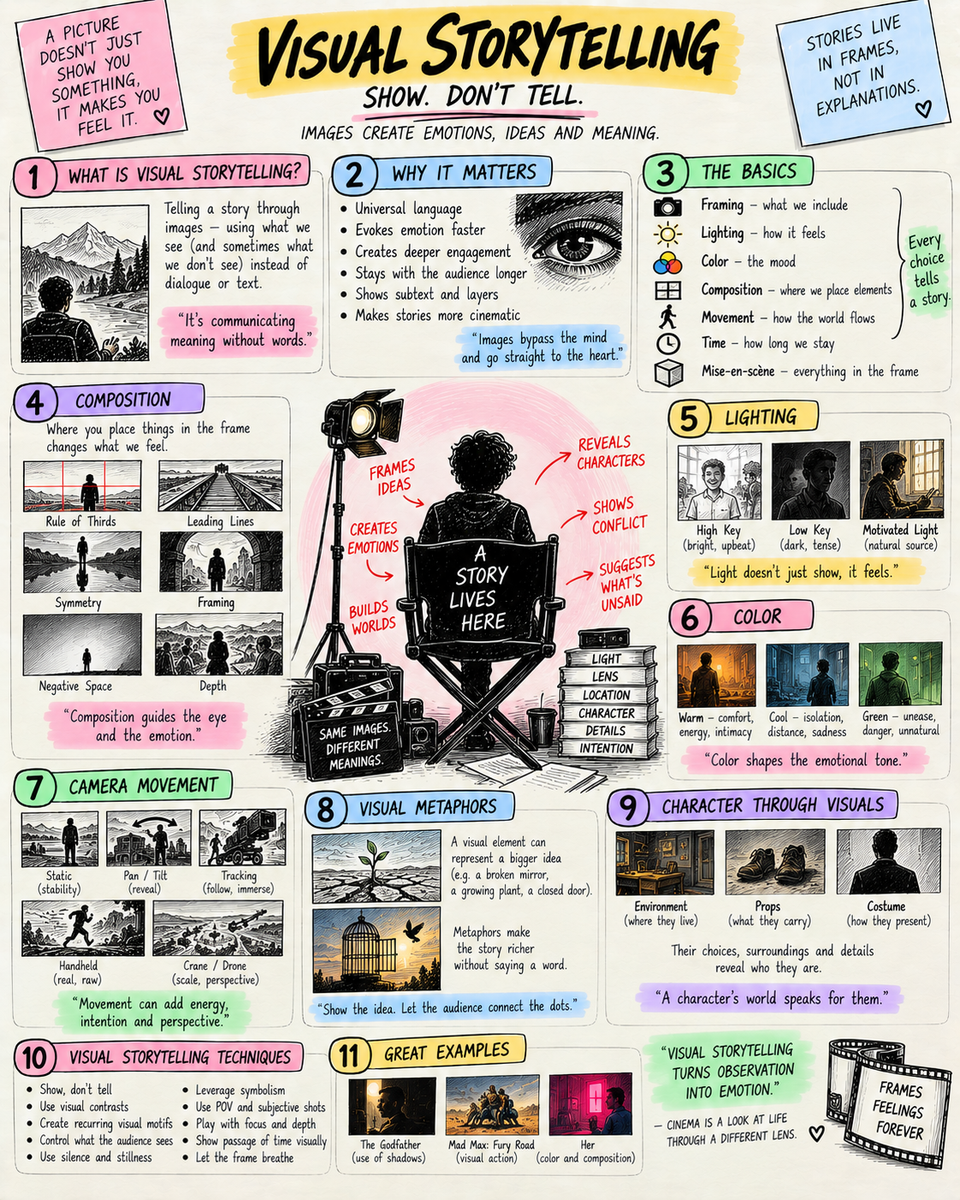
Visual storytelling means communicating ideas, emotions and meaning through images.
A character doesn't always have to say:
“I'm lonely.”
Maybe you show them sitting alone at a dining table while an untouched second plate sits opposite them.
The audience understands.
That's visual storytelling.
The Basics
Framing — What do we include?
Lighting — How does it feel?
Colour — What is the mood?
Composition — Where do we place things?
Movement — How does the world flow?
Time — How long do we stay?
Mise-en-scène — Everything inside the frame.
Every choice can tell a story.
8. Composition Changes Meaning
Where you place something in the frame affects how the audience feels.
Some basic tools include:
Rule of thirds
Leading lines
Symmetry
Framing
Negative space
Depth
The same character can feel powerful, lonely, trapped or insignificant simply because of how you compose the shot.
Composition guides the eye and the emotion.
9. Lighting Creates Emotion
Lighting isn't simply about making the subject visible.
It creates feeling.
High Key
Bright and open.
Low Key
Dark and tense.
Motivated Light
The light appears to come naturally from a source within the scene.
Light doesn't just show. It feels.
10. Colour Is Also Storytelling
Colour can communicate emotion and atmosphere.
For example:
Warm → comfort, energy, intimacy
Cool → isolation, distance, sadness
Green → unease, danger, unnatural feeling
Colour can also support:
character arcs,
genre,
tone,
visual consistency.
Think of colour as:
A silent storyteller.
11. Camera Movement Has Meaning
Camera movement shouldn't happen simply because it looks cool.
Different movements can create different experiences.
Static → stability
Pan / Tilt → reveal
Tracking → follow or immerse
Handheld → raw, real
Crane / Drone → scale and perspective
The camera should have a reason to move.
Movement can add energy, intention and perspective.
12. Lenses Change Reality
Different lenses create different visual experiences.
Wide Angle
Captures more and exaggerates space.
Standard
Closer to normal human perspective.
Telephoto
Compresses space and isolates subjects.
Macro
Reveals extreme detail.
Anamorphic
Creates a wider cinematic frame, lens flares and shallow depth of field.
The lesson is simple:
Different lenses. Different realities.
13. Don't Forget Sound
You don't just watch a film.
You hear it.
Sound includes:
Dialogue
Ambience
Sound effects
Music
Silence
Diegetic Sound
Exists inside the story world.
For example:
characters talking,
footsteps,
a radio playing,
a door closing.
Non-Diegetic Sound
Exists for the audience rather than the characters.
For example:
background score,
voice-over in many cases,
stylised sound effects.
Both can completely change how a scene feels.
14. Silence Is Also Sound
Sometimes the most powerful sound is no sound at all.
Silence can:
build tension,
create focus,
make a moment feel bigger,
allow an emotion to sink in.
Think about a horror scene.
Sometimes you don't need a loud musical cue.
You just need silence…
and the audience starts imagining what might happen.
Sometimes what we don't hear says the most.
15. Sound Design Creates the World
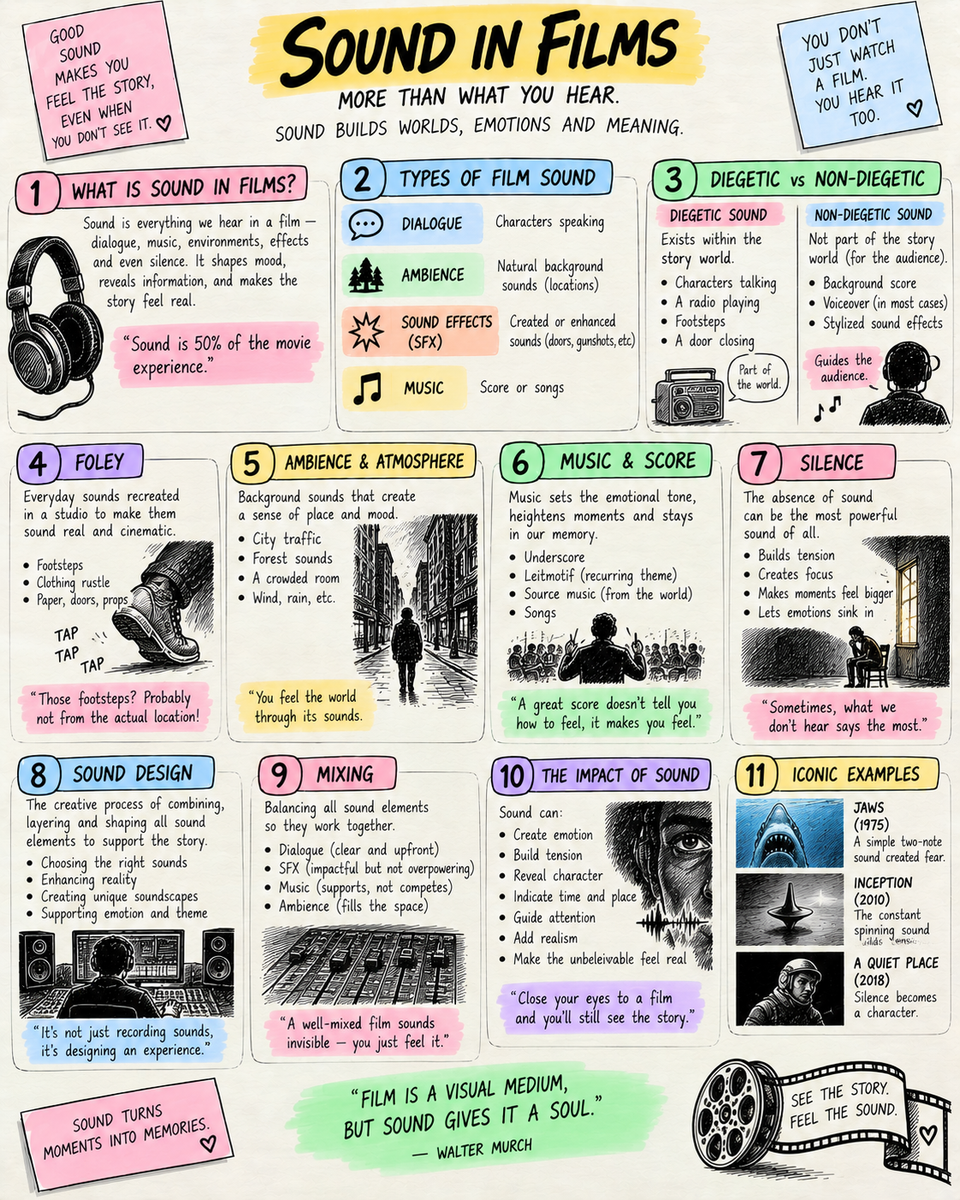
Sound design is the creative process of combining, layering and shaping sounds to support the story.
It can:
choose the right sounds,
enhance realism,
create unique soundscapes,
support emotion and theme.
Then comes mixing—balancing dialogue, sound effects, music and ambience so they work together.
A good mix doesn't call attention to itself.
You simply feel it.
16. Editing Turns Footage Into a Film
You can shoot thousands of beautiful shots.
But until you arrange them…
you don't have a movie.
Editing is the process of selecting and combining shots to create a coherent emotional story.
The editor shapes:
flow,
rhythm,
pacing,
structure,
emotion.
The basic process is:
Ingest → Assembly Cut → Fine Cut → Polish → Final Export
17. Different Cuts Create Different Feelings
Continuity Editing
Smooth, invisible editing that maintains time and space.
Montage
A series of shots showing the passage of time, ideas or emotion.
Parallel Editing
Cuts between two or more storylines happening at the same time.
Jump Cut
A deliberate, noticeable cut that creates a jarring effect.
Match Cut
Connects two shots through a visual or thematic similarity.
Cross Cutting
Alternates between scenes to build tension.
The same footage can create completely different emotions depending on how you edit it.
Same footage. Different order. Different emotion.
18. Editing Controls What the Audience Feels
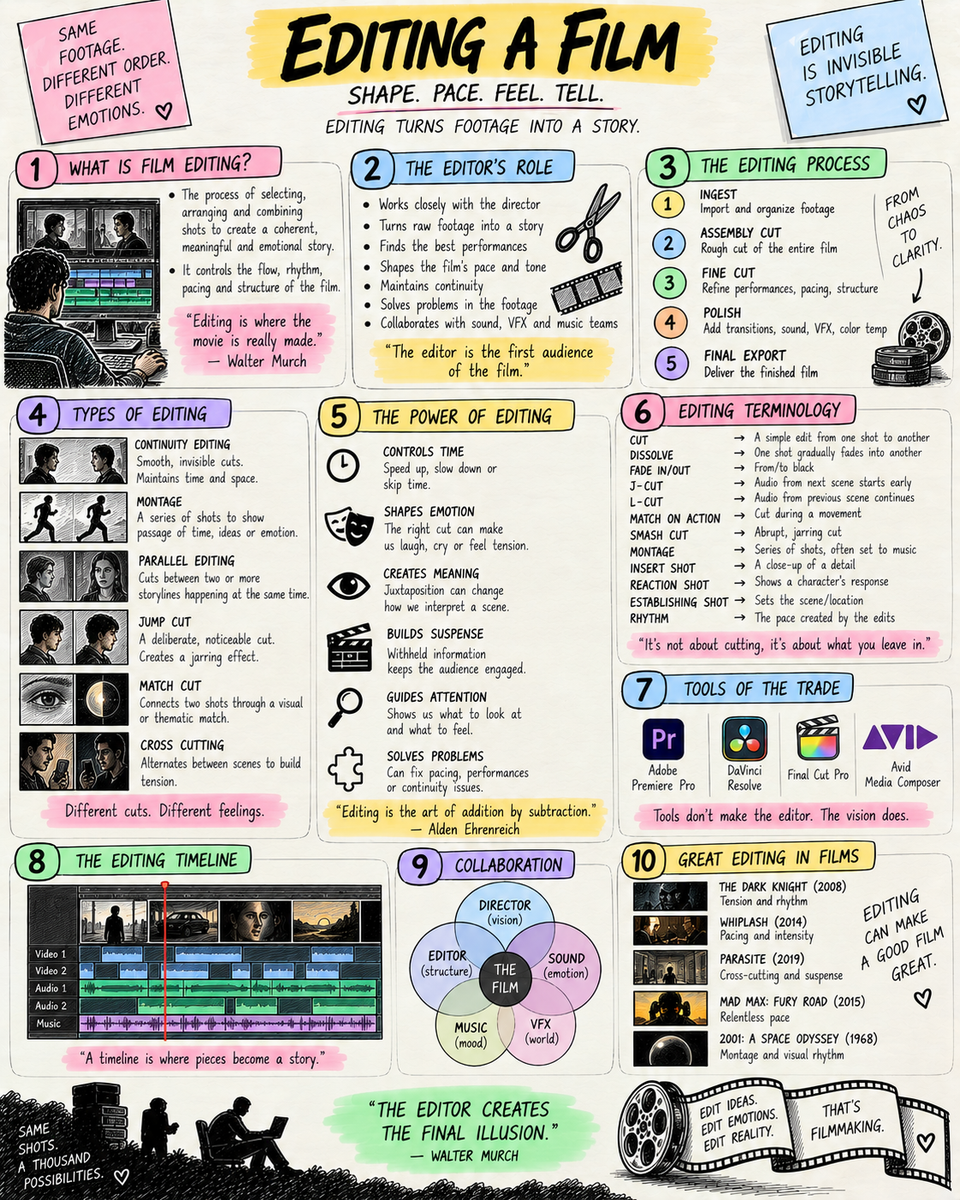
Editing can:
Control time
Speed it up, slow it down or skip it.
Shape emotion
Make us laugh, cry or feel tension.
Create meaning
Put two images together and the audience may interpret them differently.
Build suspense
Withhold information.
Guide attention
Tell us what to look at and when.
Solve problems
Fix pacing, performances or continuity issues.
That's why editing isn't simply cutting footage.
It's storytelling through selection.
19. Cinema Is All These Things Working Together
A film isn't made by one department alone.
The director brings the vision.
The cinematographer shapes the image.
The editor shapes the structure.
Sound creates emotion.
Music creates mood.
VFX can build the world.
And all of them have to work together to create one experience.
That's why filmmaking is collaborative.
The goal isn't for every department to show off.
The goal is for the film to work.
The Basics of Cinema
If you strip cinema down to its simplest form, it comes back to this:
Story gives us something to care about.
Structure gives the story shape.
Screenplay puts the movie on paper.
Cinematography turns words into images.
Visual storytelling lets images communicate without explanation.
Sound gives the world emotion and life.
Editing decides what the audience sees, when they see it and how long they feel it.
And finally…
all of it comes together to make the audience feel something.
That's cinema.
You don't need to master everything in one day.
Start with the story.
Understand the character.
Learn to see.
Learn to listen.
Learn why a cut works.
Learn why a frame feels powerful.
Then keep making films.
Because the more you understand the basics, the more intentionally you can break the rules.
Different stories. Different worlds. Different filmmakers.
But at the heart of cinema:
People. Conflict. Emotion. Change.
And a story worth telling.
To help you further and get better at the craft, we have created a filmmaker tool kit, if you like the above content then, you will definitely love our toolkit,
We created a filmmaker toolkit, which helps you in your filmmaking journey!
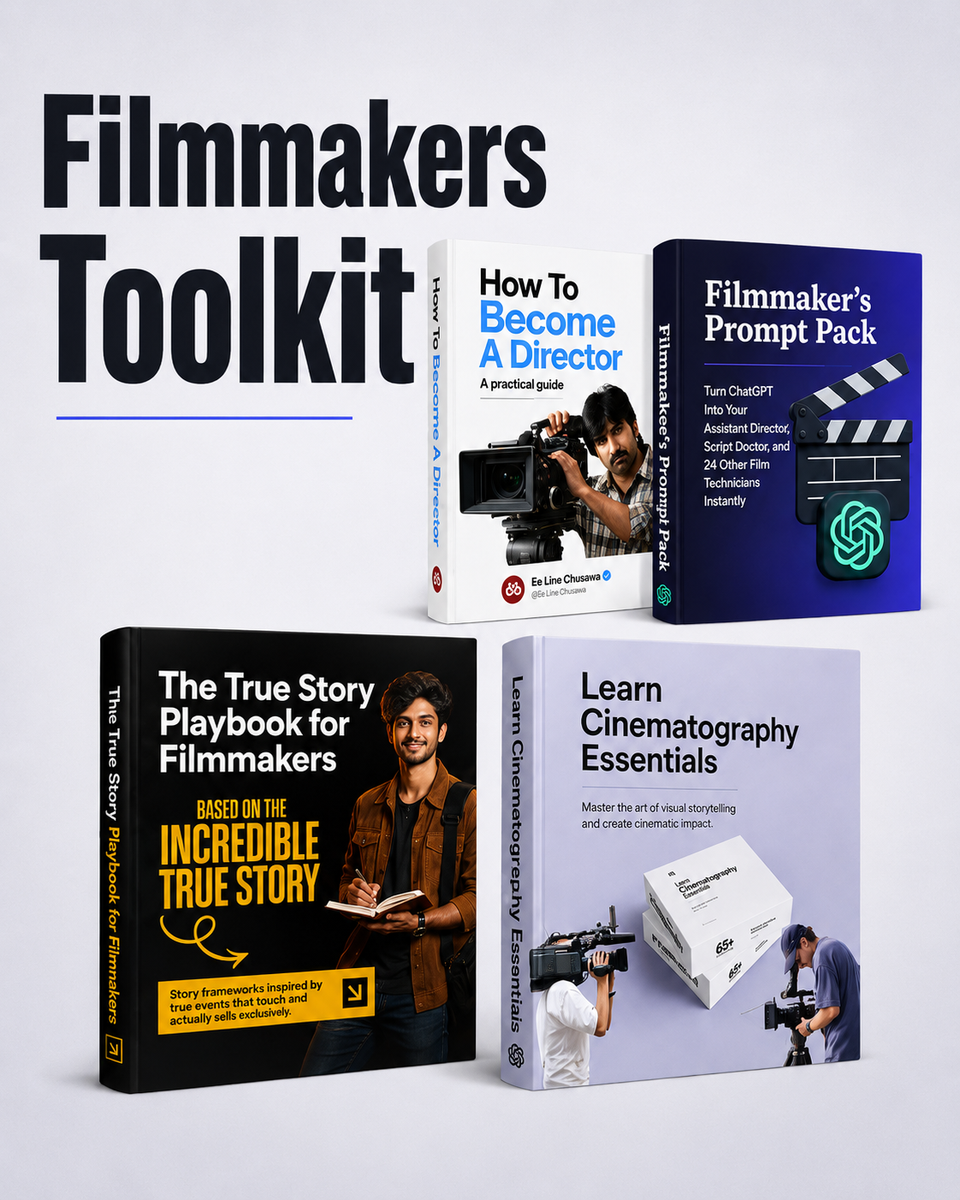
Get this now: https://superprofile.bio/vp/GHHQql4H