The Screenplay Structures Every Filmmaker Should Know
Before you write a screenplay, you need to understand one simple thing:
A screenplay is a movie written down.
It is the blueprint that tells directors, actors and crew what we see, hear and experience on screen. It uses a specific format so everyone can understand and produce the film.
But screenplay writing is not just about formatting.
You also need to understand how stories are structured.
Here are six essential frameworks every aspiring filmmaker should know.
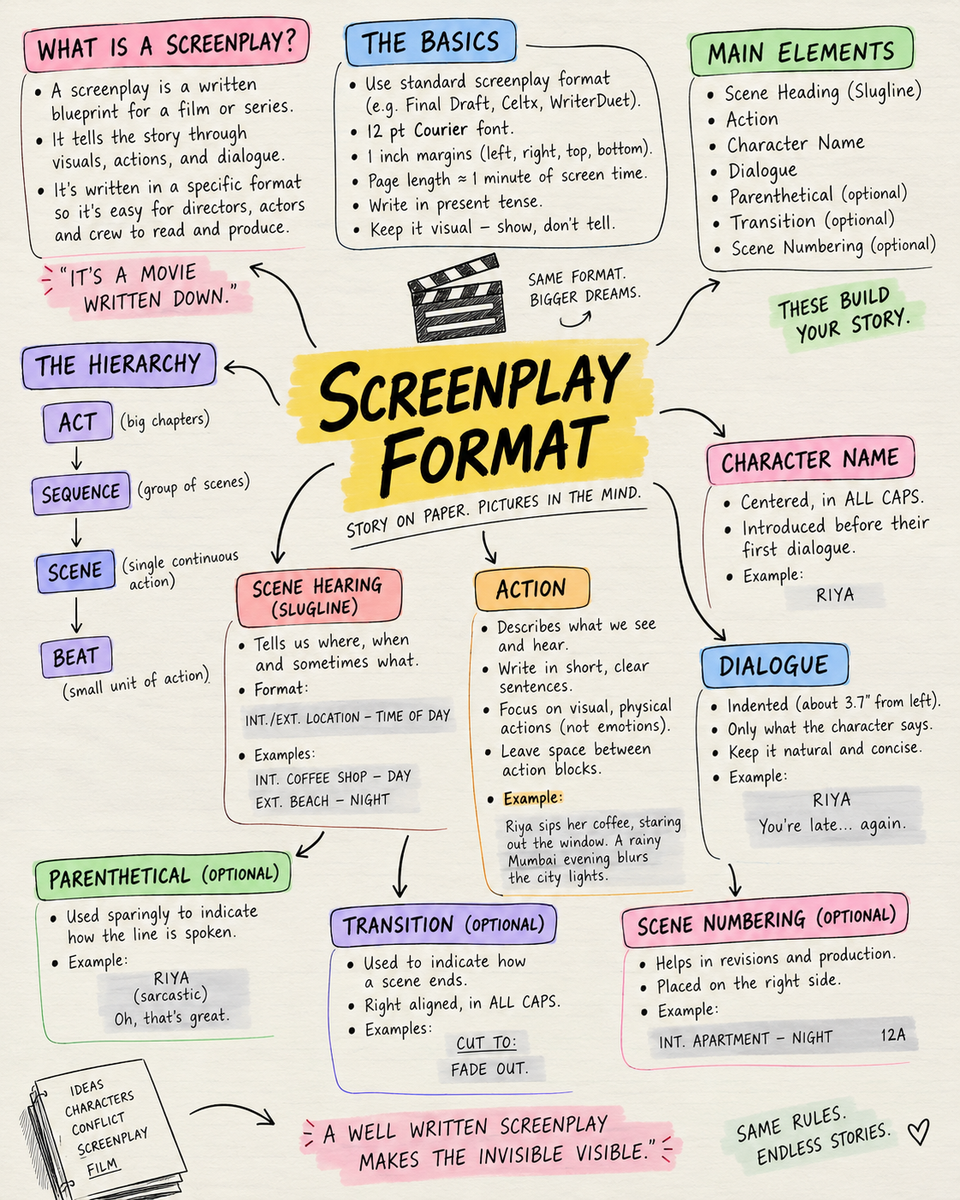
1. Screenplay Format: Learn the Language First
A screenplay is written differently from a novel.
You don't write what the character is thinking.
You write what the audience can see and hear.
The Basic Rules
Use standard screenplay software such as Final Draft, Celtx or WriterDuet.
Use 12-point Courier font.
Follow standard one-inch margins.
One screenplay page roughly equals one minute of screen time.
Write in present tense.
Keep it visual: show, don't tell.
Think of it as:
A movie written down.
The Main Elements
A screenplay is primarily built from:
Scene Heading / Slugline
Tells us where and when the scene happens.
Example:
INT. COFFEE SHOP – DAY
EXT. BEACH – NIGHT
Action
Describes what we see and hear. Keep it visual, clear and concise. Focus on physical actions rather than explaining emotions.
Character Name
Centered and written in CAPS before their dialogue.
Dialogue
What the character actually says. Keep it natural and concise.
Parenthetical
Optional. Use sparingly when you need to indicate how a line is spoken.
Transition
Optional. Indicates how a scene ends, such as:
CUT TO:
FADE OUT.
Scene Numbering
Optional in early drafts, but useful during revisions and production.
Understand the Hierarchy
A screenplay has different levels:
ACT → SEQUENCE → SCENE → BEAT
An Act is a major chapter of the story.
A Sequence is a group of connected scenes.
A Scene is a single continuous piece of action.
A Beat is the smallest unit of action or change.
So when you break down a screenplay, you can move from the biggest level to the smallest:
Act → Sequence → Scene → Beat
And remember:
A well-written screenplay makes the invisible visible.
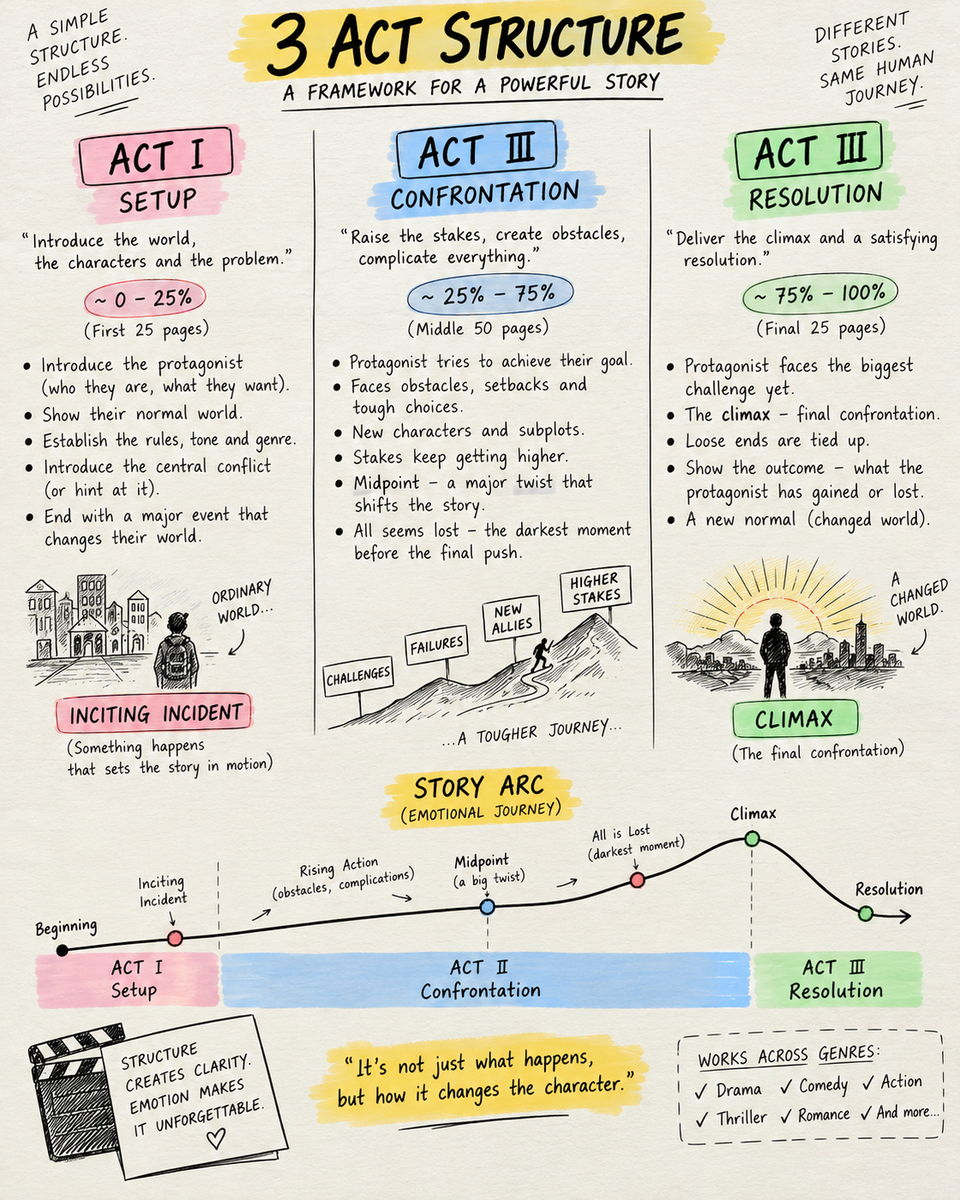
2. The Three-Act Structure
The Three-Act Structure is one of the simplest ways to understand the journey of a story.
It divides the screenplay into:
ACT I — SETUP
0–25%
Introduce:
the protagonist,
their ordinary world,
what they want,
the rules of the world,
the genre and tone,
the central conflict.
Then something happens that changes their world.
This is the Inciting Incident.
The story is now in motion.
ACT II — CONFRONTATION
25–75%
This is where the protagonist tries to achieve their goal.
But things keep getting harder.
We see:
obstacles,
failures,
difficult choices,
new characters,
subplots,
rising stakes.
Then comes the Midpoint—a major twist or development that changes the direction of the story.
The pressure continues to increase until the protagonist reaches their darkest point.
This is often called All Is Lost.
ACT III — RESOLUTION
75–100%
Now the protagonist faces their biggest challenge.
The story reaches its:
Climax.
The final confrontation happens.
Loose ends are tied together.
We see what the protagonist has gained or lost and what their world looks like after everything they've experienced.
The important thing is:
It's not just what happens. It's how what happens changes the character.
This structure works across drama, comedy, thriller, romance, action and many other genres.
3. Save the Cat: 15 Beats
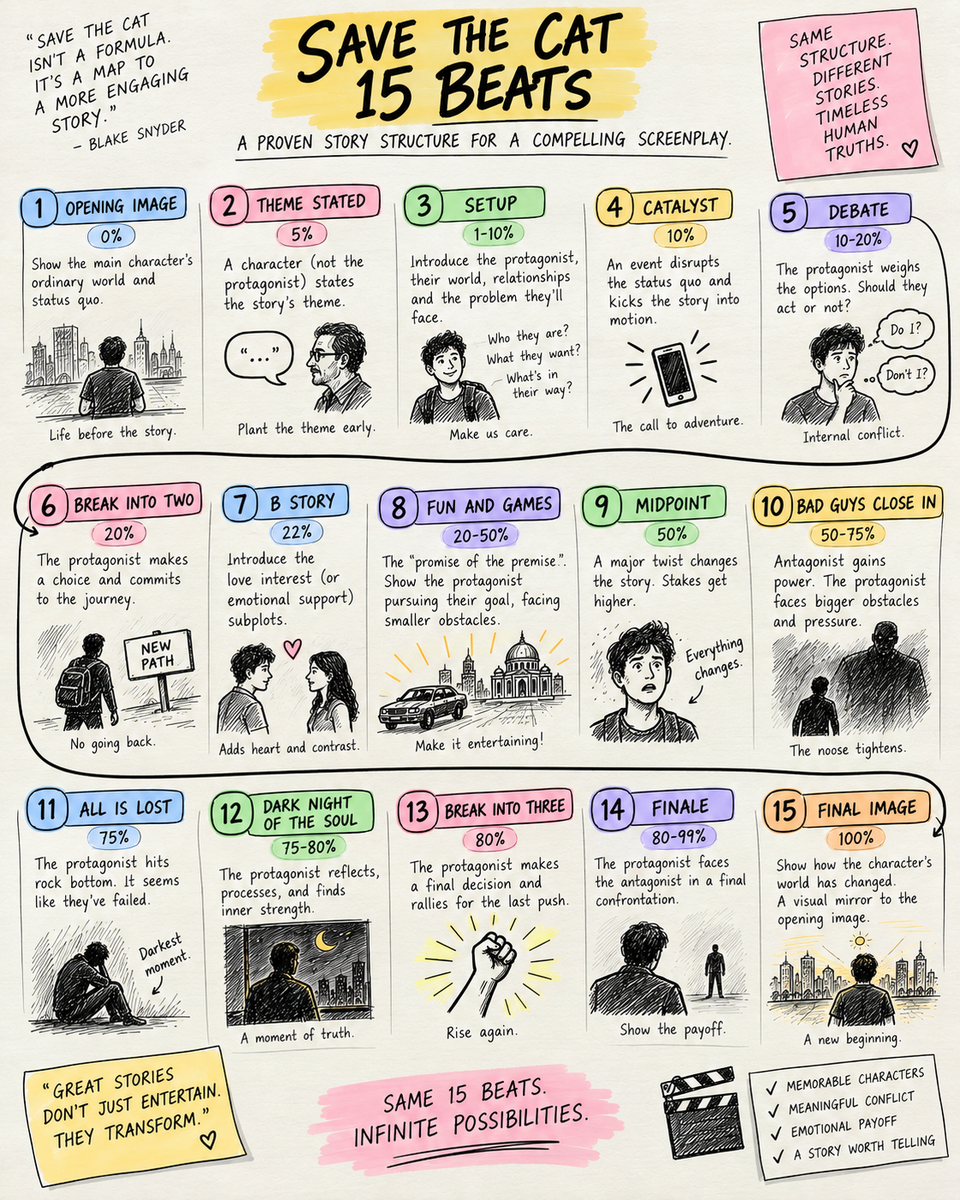
The Three-Act Structure gives you the big picture.
Save the Cat gives you a more detailed roadmap.
It breaks a screenplay into 15 story beats.
ACT I — SETUP
1. Opening Image — 0%
Show the protagonist's ordinary world and current status quo.
2. Theme Stated — 5%
Someone states or demonstrates the central theme of the story.
3. Setup — 1–10%
Introduce the protagonist, their world, relationships, wants and problems.
4. Catalyst — 10%
Something disrupts the status quo and starts the story.
5. Debate — 10–20%
The protagonist questions what to do. Should they act or not?
ACT II — CONFRONTATION
6. Break into Two — 20%
The protagonist makes a choice and enters a new situation.
7. B Story — 22%
Introduce the emotional relationship, love interest or supporting story.
8. Fun and Games — 20–50%
Deliver the promise of the premise. The protagonist pursues the goal while facing smaller obstacles.
9. Midpoint — 50%
A major twist changes the story. The stakes become higher.
10. Bad Guys Close In — 50–75%
The antagonist gains power. Pressure increases.
ACT III — RESOLUTION
11. All Is Lost — 75%
The protagonist hits rock bottom.
12. Dark Night of the Soul — 75–80%
The protagonist reflects, processes what happened and finds inner strength.
13. Break into Three — 80%
The protagonist makes a final decision and prepares for the last push.
14. Finale — 80–99%
The protagonist faces the antagonist or biggest final challenge.
15. Final Image — 100%
Show how the protagonist's world has changed.
The power of Save the Cat isn't that every movie must follow it mechanically.
It's a map.
Same 15 beats. Infinite possibilities.
4. The Seven Basic Plots
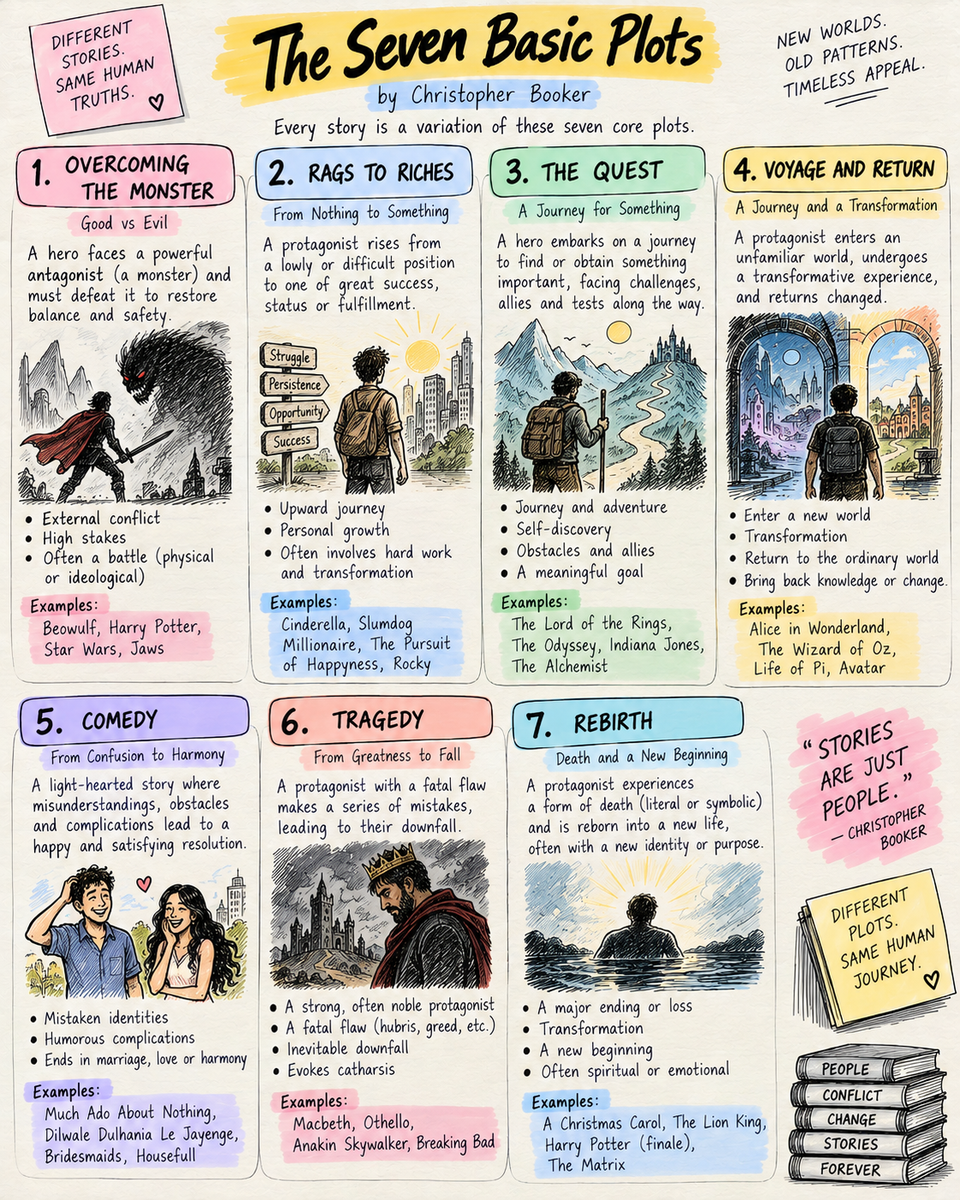
Christopher Booker's Seven Basic Plots looks at stories from a different perspective.
The idea is simple:
Different stories often explore the same fundamental human journeys.
1. Overcoming the Monster
A hero faces a powerful antagonist and must defeat them.
Core idea: Good vs Evil
Examples:
Beowulf, Harry Potter, Star Wars, Jaws
2. Rags to Riches
A protagonist rises from a difficult or ordinary position to success, status or fulfilment.
Core idea: Upward transformation
Examples:
Cinderella, Slumdog Millionaire, The Pursuit of Happyness, Rocky
3. The Quest
A hero goes on a journey to find or achieve something important.
They face obstacles, meet allies and undergo tests.
Examples:
The Lord of the Rings, The Odyssey, Indiana Jones, The Alchemist
4. Voyage and Return
A protagonist enters an unfamiliar world, experiences transformation and eventually returns to their ordinary world changed.
Examples:
Alice in Wonderland, The Wizard of Oz, Life of Pi, Avatar
5. Comedy
Confusion, misunderstandings and complications eventually lead toward harmony.
Examples:
Much Ado About Nothing, Dilwale Dulhania Le Jayenge, Bridesmaids, Housefull
6. Tragedy
A strong protagonist has a fatal flaw that leads to a series of mistakes and eventually their downfall.
Examples:
Macbeth, Othello, Anakin Skywalker, Breaking Bad
7. Rebirth
A protagonist experiences a form of death—literal or symbolic—and is reborn into a new life, identity or purpose.
Examples:
A Christmas Carol, The Lion King, Harry Potter, The Matrix
The bigger idea is:
Different plots. Same human journeys.
5. The Rashomon Structure
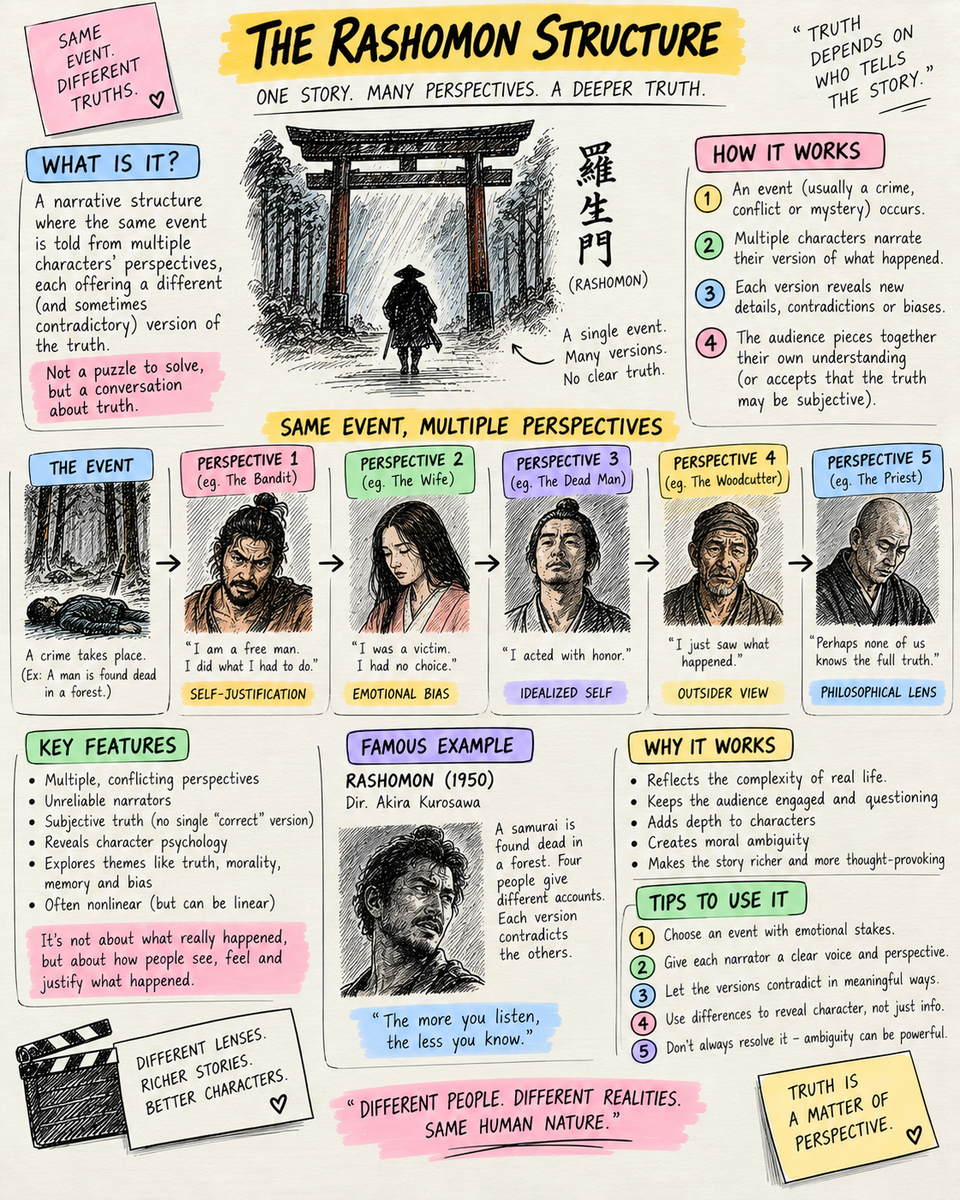
What if the same event could have completely different truths?
That's the idea behind the Rashomon Structure, famously associated with Akira Kurosawa's Rashomon.
A single event is presented through multiple characters' perspectives.
Each person gives their version.
But their versions may contradict each other.
How It Works
1. An event happens.
Usually a crime, conflict or mystery.
2. Different characters tell their versions.
3. Each version reveals new details, contradictions or biases.
4. The audience pieces together their own understanding.
Sometimes, there is no single objective truth.
Why It Works
It explores:
truth,
morality,
memory,
bias,
character psychology.
It keeps the audience questioning what actually happened.
The key is:
It's not about what really happened, but how different people see, feel and justify what happened.
Tips for Using It
Choose an event with emotional stakes.
Give every narrator a distinct voice and perspective.
Let the versions contradict each other meaningfully.
Use contradictions to reveal character, not just information.
Don't feel forced to resolve everything. Ambiguity can be powerful.
Different people. Different realities. Same human nature.
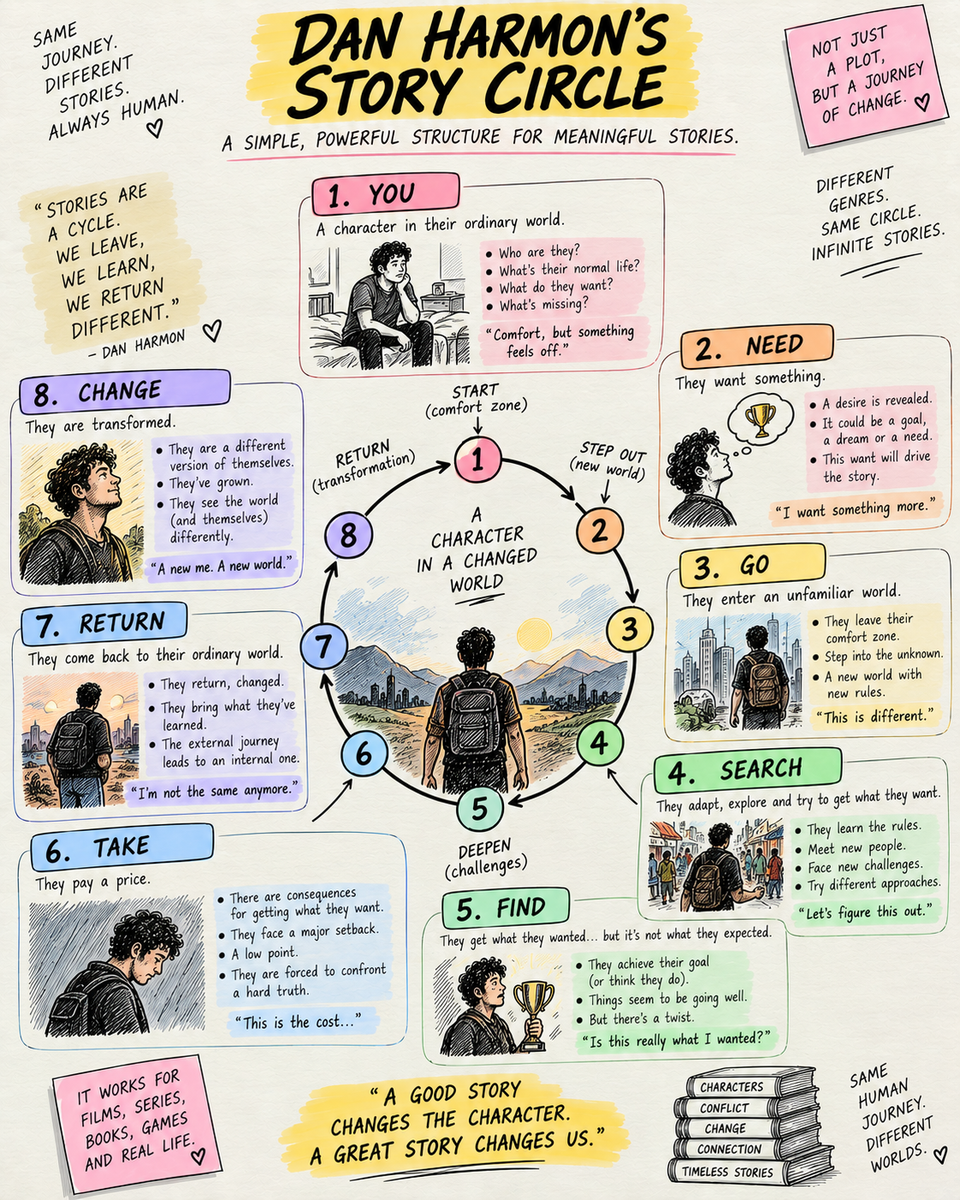
6. Dan Harmon's Story Circle
Dan Harmon's Story Circle simplifies storytelling into eight stages.
At its heart, it's about a character who enters a situation, struggles through it and comes back changed.
1. YOU
The character is in their ordinary world.
Ask:
Who are they?
What's their normal life?
What do they want?
What's missing?
Comfort, but something feels wrong.
2. NEED
The character wants something.
This could be:
a goal,
a dream,
a desire,
a need.
This desire drives the story.
3. GO
They leave their comfort zone and enter an unfamiliar world.
New environment.
New rules.
New problems.
4. SEARCH
They adapt.
They explore.
They try different approaches.
They meet people and face challenges while pursuing what they want.
5. FIND
They get what they wanted—or think they did.
But it may not be what they expected.
The question becomes:
"Is this really what I wanted?"
6. TAKE
They pay a price.
There are consequences.
They face a major setback and are forced to confront a difficult truth.
7. RETURN
They return to their ordinary world.
But they aren't the same person anymore.
The external journey becomes an internal one.
8. CHANGE
They are transformed.
They see themselves and their world differently.
They return as a different version of themselves.
That's the heart of the Story Circle:
A character enters a changed world and returns changed themselves.
And this structure isn't limited to feature films.
It can work for:
films,
series,
books,
games,
even individual stories and real-life experiences.
7.The Hero’s Journey: A Simple Structure for Powerful Stories
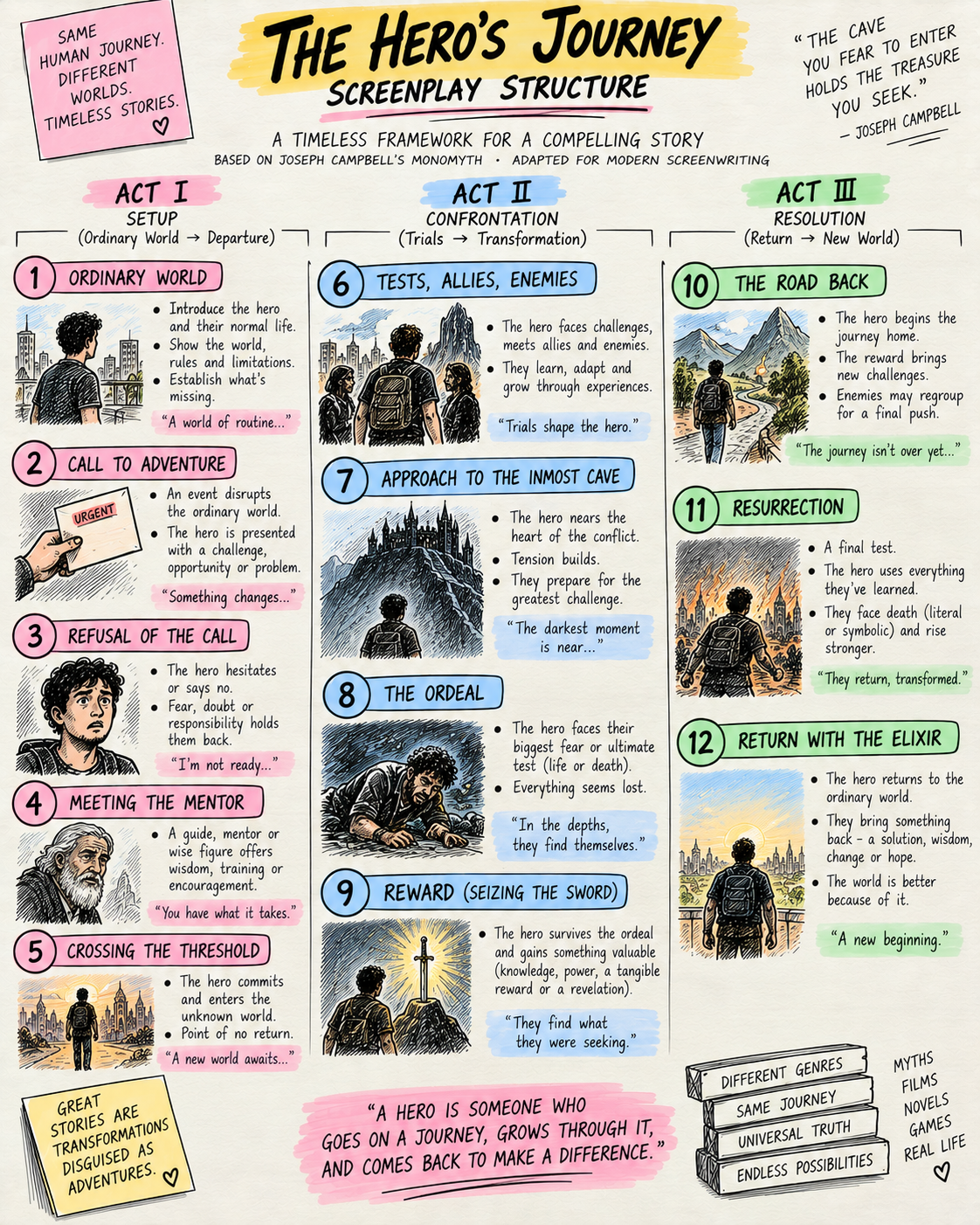
Most stories are about someone who leaves the life they know, enters an unfamiliar world, faces challenges, changes through the experience, and returns as a different person.
That is the basic idea behind The Hero’s Journey, a storytelling framework based on Joseph Campbell’s work and later adapted for modern screenwriting.
It gives you a simple way to understand a character’s adventure, struggle and transformation.
ACT I — SETUP
Ordinary World → Departure
1. Ordinary World
Introduce the hero and their normal life.
Show:
Who they are
Their world
Its rules and limitations
What is missing from their life
This is the world before the story changes everything.
“A world of routine…”
2. Call to Adventure
Something disrupts the hero's ordinary world.
They receive:
a challenge,
an opportunity,
a problem,
or a responsibility.
Something changes.
“Something changes…”
3. Refusal of the Call
The hero doesn't immediately accept the challenge.
They hesitate.
Maybe they're afraid.
Maybe they doubt themselves.
Maybe they don't want the responsibility.
This resistance makes the hero human.
“I'm not ready…”
4. Meeting the Mentor
The hero encounters someone who can guide them.
The mentor may offer:
wisdom,
training,
encouragement,
knowledge,
or simply the confidence to move forward.
“You have what it takes.”
5. Crossing the Threshold
The hero finally commits.
They leave their familiar world and enter an unfamiliar one.
This is the point of no return.
A new world awaits.
ACT II — CONFRONTATION
Trials → Transformation
6. Tests, Allies & Enemies
Now the hero has to survive in this new world.
They:
face challenges,
meet allies,
encounter enemies,
learn the rules,
adapt through experience.
These trials begin shaping the hero.
Trials shape the hero.
7. Approach to the Inmost Cave
The hero moves closer to the heart of the conflict.
The tension increases.
They prepare for the greatest challenge yet.
The darkest moment is getting closer.
8. The Ordeal
The hero faces their biggest fear or ultimate test.
It can involve:
physical danger,
emotional destruction,
failure,
or even death—literal or symbolic.
Everything seems lost.
But this is where the hero discovers something about themselves.
“In the depths, they find themselves.”
9. Reward — Seizing the Sword
The hero survives the ordeal.
And now they gain something valuable.
It could be:
knowledge,
power,
a revelation,
a tangible reward,
or something they were searching for.
They have earned something because of what they went through.
“They find what they were seeking.”
ACT III — RESOLUTION
Return → New World
10. The Road Back
The hero begins their journey home.
But the story isn't over.
The reward may create new challenges.
Enemies may regroup.
The hero has to deal with the consequences of everything that happened.
“The journey isn't over yet…”
11. Resurrection
The hero faces one final test.
This is the moment where they use everything they have learned.
They may face death—literally or symbolically—and rise stronger.
The person who entered the journey is no longer the same person.
“They return transformed.”
12. Return with the Elixir
The hero finally returns to their ordinary world.
But they bring something back.
It could be:
a solution,
wisdom,
knowledge,
hope,
or change.
And because of what they learned, their world is better.
A new beginning.
The Hero's Journey in One Line
Ordinary World → Call → Refusal → Mentor → Threshold → Tests → Ordeal → Reward → Road Back → Resurrection → Return
The important thing isn't simply that your hero goes on an adventure.
The hero must change because of the adventure.
That's why this structure works across:
Films • Novels • Games • Myths • Real Life
Different genres.
Different worlds.
Different characters.
But the same fundamental human journey.
“A hero is someone who goes on a journey, grows through it, and comes back to make a difference.”
And that's the real power of The Hero's Journey.
Great stories are often transformations disguised as adventures.
So Which Structure Should You Use?
This is where many beginner writers get confused.
They ask:
"Which is the correct structure?"
There isn't one.
The Three-Act Structure helps you understand the overall architecture.
Save the Cat gives you 15 detailed beats.
The Seven Basic Plots helps you understand the type of human journey you're telling.
The Rashomon Structure helps you explore multiple perspectives and subjective truth.
Dan Harmon's Story Circle helps you track a character's journey and transformation.
And screenplay format gives you the language through which all of this is written.
You can even combine them.
A film can have a Three-Act Structure, follow many Save the Cat beats, belong to one of the Seven Basic Plots, and still use a Rashomon-style perspective or a Story Circle for its protagonist.
My Two Cents
Don't use structure because someone told you:
"This is the formula."
Use structure because it helps you understand your story.
At the end of the day, every structure is trying to help you answer a few fundamental questions:
Who is the character?
What do they want?
What stands in their way?
What happens to them?
What does it cost them?
And who do they become by the end?
Learn the frameworks.
Break them down.
Study films you love.
Then write.
Because structure creates clarity.
But emotion is what makes a story unforgettable.
To help you further and get better at the craft, we have created a filmmaker tool kit, if you like the above content then, you will definitely love our toolkit,
We created a filmmaker toolkit, which helps you in your filmmaking journey!

Get this now: https://superprofile.bio/vp/GHHQql4H